
Eivind Kjosbakken — Claude Code & Coding Agent Workflows

Eivind Kjosbakken — Claude Code & Coding Agent Workflows

4 Techniques to Optimize Your LLM Prompts for Cost, Latency and Performance

Learn how to greatly improve the performance of your LLM application

Eivind Kjosbakken's avatar
Eivind Kjosbakken
Jan 16, 2026
∙ Paid
Learn how to vastly improve LLM performance with the 4 low-effort techniques covered in this article.
Learn how to vastly improve LLM performance with the 4 low-effort techniques covered in this article. Image by ChatGPT.

LLMs are capable of automating a significant number of tasks. Since the release of ChatGPT in 2022, we have seen more and more AI products on the market utilizing LLMs. However, there are still a lot of improvements that should be made in the way we utilize LLMs. Improving your prompt with an LLM prompt improver and utilizing cached tokens are, for example, two simple techniques you can utilize to vastly improve the performance of your LLM application.

In this article, I’ll discuss several specific techniques you can apply to the way you create and structure your prompts, which will reduce latency and cost, and also increase the quality of your responses. The goal is to present you with these specific techniques, so you can immediately implement them into your own LLM application.
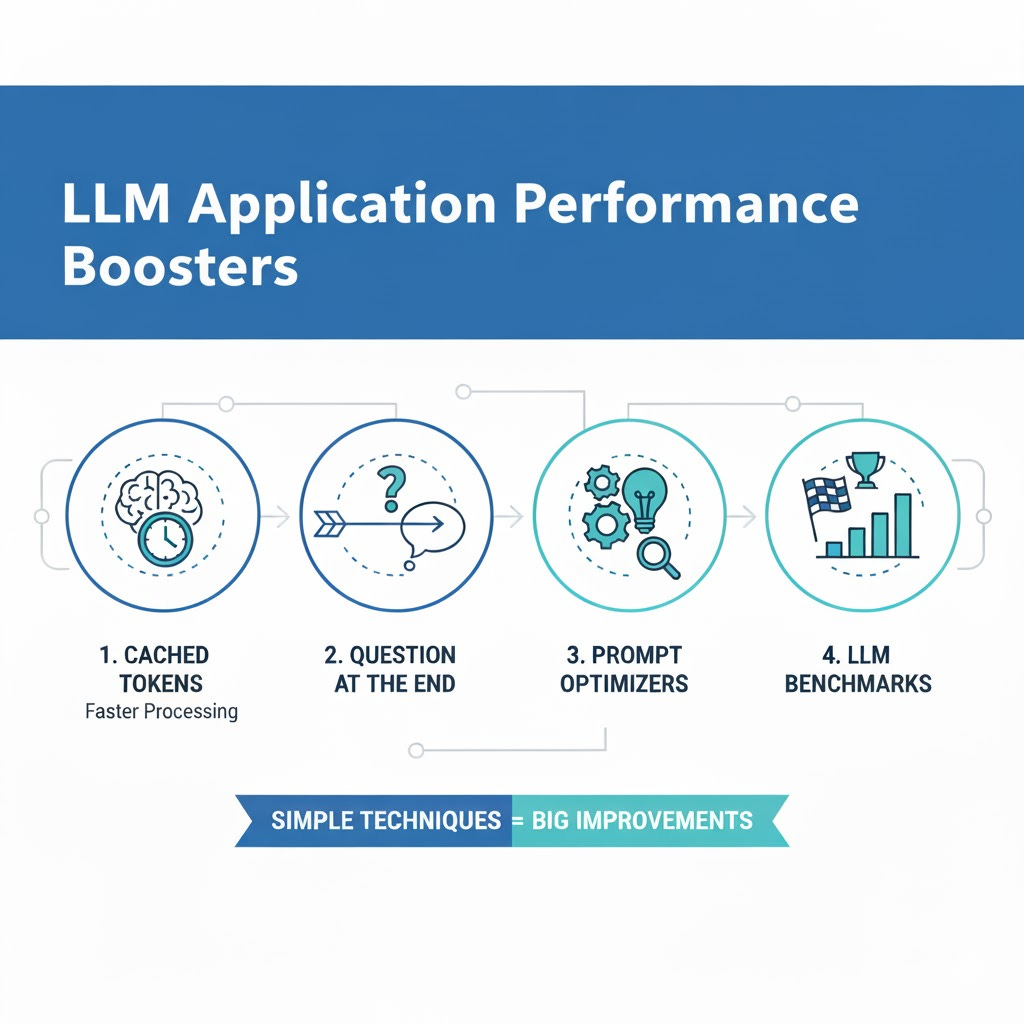
This infographic highlights the main contents of this article. I’ll discuss four different techniques to greatly improve the performance of your LLM application, with regard to cost, latency, and output quality.
This infographic highlights the main contents of this article. I’ll discuss four different techniques to greatly improve the performance of your LLM application, with regard to cost, latency, and output quality. I’ll cover utilizing cached tokens, having the user question at the end, using prompt optimizers, and having your own customized LLM benchmarks. Image by Gemini.

Why you should optimize your prompt

In a lot of cases, you might have a prompt that works with a given LLM and yields adequate results. However, in a lot of cases, you haven’t spent much time optimizing the prompt, which leaves a lot of potential on the table.

I argue that using the specific techniques I’ll present in this article, you can easily both improve the quality of your responses and reduce costs without much effort. Just because a prompt and LLM work doesn’t mean it’s performing optimally, and in a lot of cases, you can see great improvements with very little effort.

The technical breakdown and source code below are reserved for paid subscribers. Support independent technical writing and gain the efficiency edge.

User's avatar

Continue reading this post for free, courtesy of Eivind Kjosbakken.

Or purchase a paid subscription.
© 2026 Eivind Kjosbakken · Privacy ∙ Terms ∙ Collection notice
Start your SubstackGet the app
Substack is the home for writing, podcasting, and media founders.