


The development of LLMs has fundamentally changed the way we think and work. LLMs are powerful models that can automate tedious tasks, provide large-scale customer support, and make research far more effective. However, it’s challenging to determine the most effective way to utilize AI in both your day-to-day life and your business. In this article, I will therefore dive into how you can get the most out of powerful large language models.
Table of Contents
Motivation
Changing the way you think
Vertical AI
Diving into use cases
Cognitive decline
Conclusion
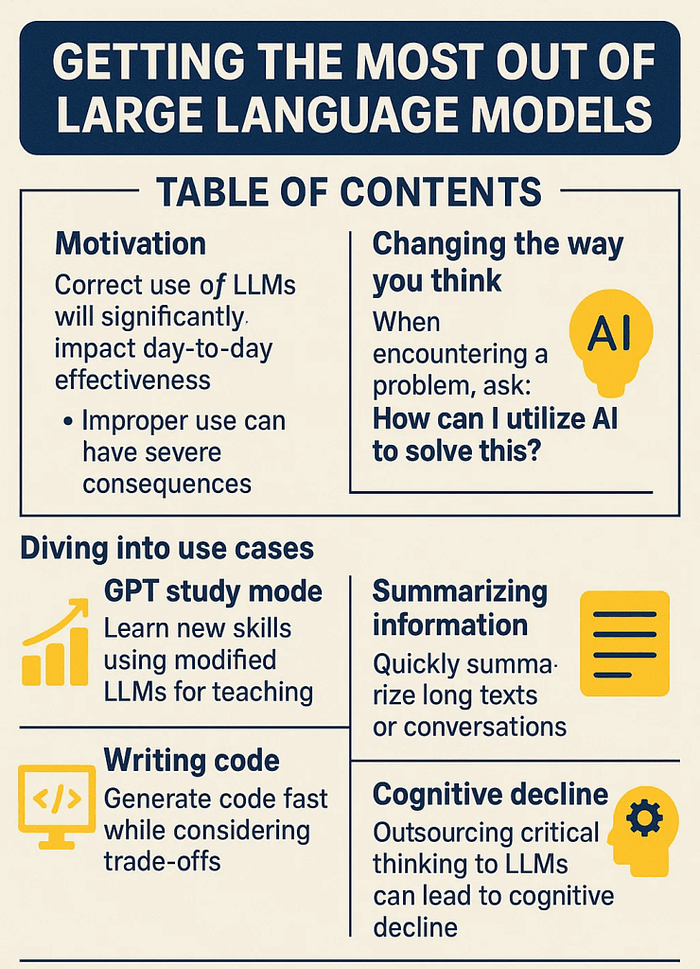
The figure highlights the main points of this article. I will discuss why you should care about effectively utilizing LLMs, how to think about LLM problem-solving, and applications of LLMs. Image by ChatGPT.
You can also learn about How to Benchmark LLMs — ARC AGI 3, or you can read about ensuring reliability in LLM applications.
Motivation
My motivation for this article is that the correct use of LLMs will have one of the most significant impacts on your effectiveness in day-to-day life. However, the incorrect use of LLMs can quickly turn this around, for example, not knowing how your code implementation works, or if you outsource all of your critical thinking. My main goal for this article is therefore to open your mind to how you can apply LLMs (hopefully uncovering some use cases you haven’t thought about), and also warn you of where improper use of LLMs can have severe consequences.
I primarily discuss the application of AI in the workplace, although it can also be effectively implemented in other aspects of your life.
Changing the way you think
When encountering a new problem, your first thought should immediately be:
How can I utilize AI to solve this problem
For example, I’ve never created a Slack bot before. Before LLMs, you would probably Google How to create a Slack bot, spend too much time going through Slack documentation, and finally, in a few hours, implement the Slack bot.
With LLMs, your first intuition should be to open ChatGPT (or any other provider, such as Gemini, Anthropic, Mistral, Grok, etc.) and ask for a step-by-step guide to creating a Slack bot. This example may seem simple, but I recommend applying it to every problem you encounter. For example:
If you need to find an LLM provider that is GDPR compliant and accepts all file types
Or if you’re wondering how to weigh the pros and cons of a software architecture decision
My personal experience was that I applied AI to the most apparent problems, but I didn’t apply it when the benefit of AI was less evident to me. However, the benefit wasn’t hidden because using AI wouldn’t be efficient. Instead, it was hidden from me because I hadn’t previously applied AI to that type of problem.
One eye-opening experience for me was reading an article about how you can utilize LLMs to review your writing statistics and improve your writing. I put all of my articles and stats for each article (number of words, the headline, the weekday the article was published, etc.) and had the LLM analyze all my statistics and provide insights into what performs well and what doesn’t. This was a true A-HA! moment for me, where I uncovered an application of LLMs I hadn’t thought about before. Of course, this application of LLMs can be extended to other statistics and patterns, and will likely yield valuable insights.
Vertical AI
Vertical AI is a super relevant topic lately. The concept refers to how AI can solve specific problems, and they are usually built on top of frontier LLMs such as GPT-5 from OpenAI, Claude 4 from Anthropic, or Grok 4 from xAI. Vertical AI is about creating AI-powered solutions that can be applied to specific problems and challenges. An example of vertical AI is utilizing GPT-5 to analyze your calendar and provide notifications for tasks that need to be completed before meetings.
The reason I bring up vertical AI is that we currently have access to extremely powerful LLMs that are still not being applied to all the problems they can solve. There are still a plethora of issues out there that we have yet to apply AI to, where LLMs can have a significant impact. A lot of startups are built on precisely this concept.
Take an LLM, apply it to a super specfic problem, sell it to people who struggle with this problem
The main takeaway from this section is that there are probably parts of your work that can still benefit from using LLMs. Maybe you have a workflow that you repeat often, and would save you two hours each week. Or perhaps you struggle to keep up with all the messages and emails, and it’s a constant cognitive burden to stay updated. If so, you should find a way to automate your repeated tasks or outsource the unnecessary cognitive load to make life more efficient.
Diving into use cases
There are essentially infinite areas where LLMs can be applied. In this section, I’ll discuss some of the areas I find the most useful.
GPT study mode
GPT study mode is a powerful feature that modifies GPT-5 to be better at teaching. GPT will, for example:
Ask you questions to ensure you understand the topic you’re asking about
Guide you in the most relevant direction for learning a new topic
I set aside some hours each week to learn new skills, and GPT study mode is a powerful approach to quickly acquiring new knowledge.
I enjoy the tweet from Andrej Karpathy below, which highlights how learning should feel like mental exertion. This is a feeling I strive to experience regularly to ensure I’m constantly learning new skills, and using ChatGPT study mode is one of my techniques to achieve this experience.
Summarizing information
I regularly use LLMs to summarize information for me. It could be:
Summarizing a long thread in a Slack channel to quickly obtain the most critical information
Or summarizing a long article, where I mostly want to grasp the main concept, and not necessarily understand all the details
LLMs are extremely effective summarizers, primarily because summarization is a significant part of most LLMs’ training pipelines. However, I also urge you to consider the trade-off between summaries being more efficient and the fact that reading a summary of text is not the same as understanding the text content. As a general rule of thumb, I avoid summarization when I’m trying to learn something new.
Writing code
Writing code is perhaps the most obvious use of LLMs (at least to programmers like me). However, I think LLMs for writing code are particularly interesting because of the trade-off between writing code faster and actually understanding the code you’re generating.
As a programmer using apps like Cursor, you must consider when to simply ask an LLM to write a basic function for you and when to intervene manually to maintain quality. I believe this consideration will be easier after you’ve programmed for a few years, because you can better grasp which tasks the LLM is good at, and which tasks it’s better to (partially) write the function yourself.
Cognitive decline
Before writing this article, I listened to The Diary of A CEO podcast on how using LLMs such as ChatGPT can impact your life. The podcast outlines how outsourcing your critical thinking to LLMs can lead to cognitive decline.
I think this is an important consideration to keep in mind when utilizing LLMs:
Will using an LLM here benefit me both in the short run and in the long run
In some cases, the answer will be yes in the short run, and no in the long run. Imagine, for example, a programmer who used to be really good at programming, but now only prompts the Cursor agent to write code. Naturally, not applying the skill of coding will lead to a reduction in programming proficiency (without AI). However, applying the Cursor agent also enables programmers to write code and push out new features much faster.
You therefore have to strike this balance between maintaining proficiency over the long run and ensuring efficiency in both the short and long run.
Conclusion
In this article, I discuss how you can utilize AI most efficiently in your life, with a focus on its applications in the workplace. I think the release of LLMs requires a mindset shift in how we think about solving problems, where a general first solution should often be Can I utilize an LLM to solve this for me. I discussed some applications where I utilize LLMs, such as GPT study mode and summarizing information, and I also highlighted how the use of LLMs can have negative consequences if not applied correctly.
Related reading
Get practical AI-engineering workflows in your inbox.
Get the reusable configuration behind my coding-agent workflows. The paid Vault includes global and project templates, commands, hook configuration, prompt patterns and the parallel-agent setup. Access and updates are included while subscribed.
Try the free Claude Code Setup Pack · My website · LinkedIn · X
LLMs don’t 10x productivity by default. They 10x whatever judgment and habits you already have. :)