

Negotiations have always been a core part of business and how humans operate. A lot of things in this world are negotiations, even though you might not think of it that way.
Negotiation could be discussing your salary.
It can be who’s doing the dishes at home.
It could be who’s going to hold that presentation at work, and so on.
Everything is basically a negotiation of some sort of form or some way. However, most people don’t even practice for negotiations at all.
They just go into it completely unprepared, and as you probably know, humans usually aren’t good at something without deep practice. The only way we become good at a particular skill is through extensive practice and work.
On a daily basis, I work as the CTO and co-founder of DealSharp. Which is a negotiation platform to practice and prepare before a negotiation and have help during the negotiation. In this article, I want to discuss how you can apply AI to negotiations to become a better negotiator yourself, which will help you a lot throughout your life.
What we do has taken a lot of inspiration from books such as “Never Split the Difference” and “Getting to Yes,” while also looking into the best negotiators we’ve found, which are typically lawyers negotiating for different contracts.
There are two main approaches I want to discuss on how to apply AI in negotiations:
To practice before the negotiation
To actively use AI during the negotiation
AI to practice
Let’s first discuss AI to practice for negotiations. I think there are numerous dimensions to a negotiation. The first and probably most obvious one is what you say during the negotiation: the words that you pick. This is, of course, extremely important. The words you pick can be hostile and confrontational, or they can be friendly and collaborative.
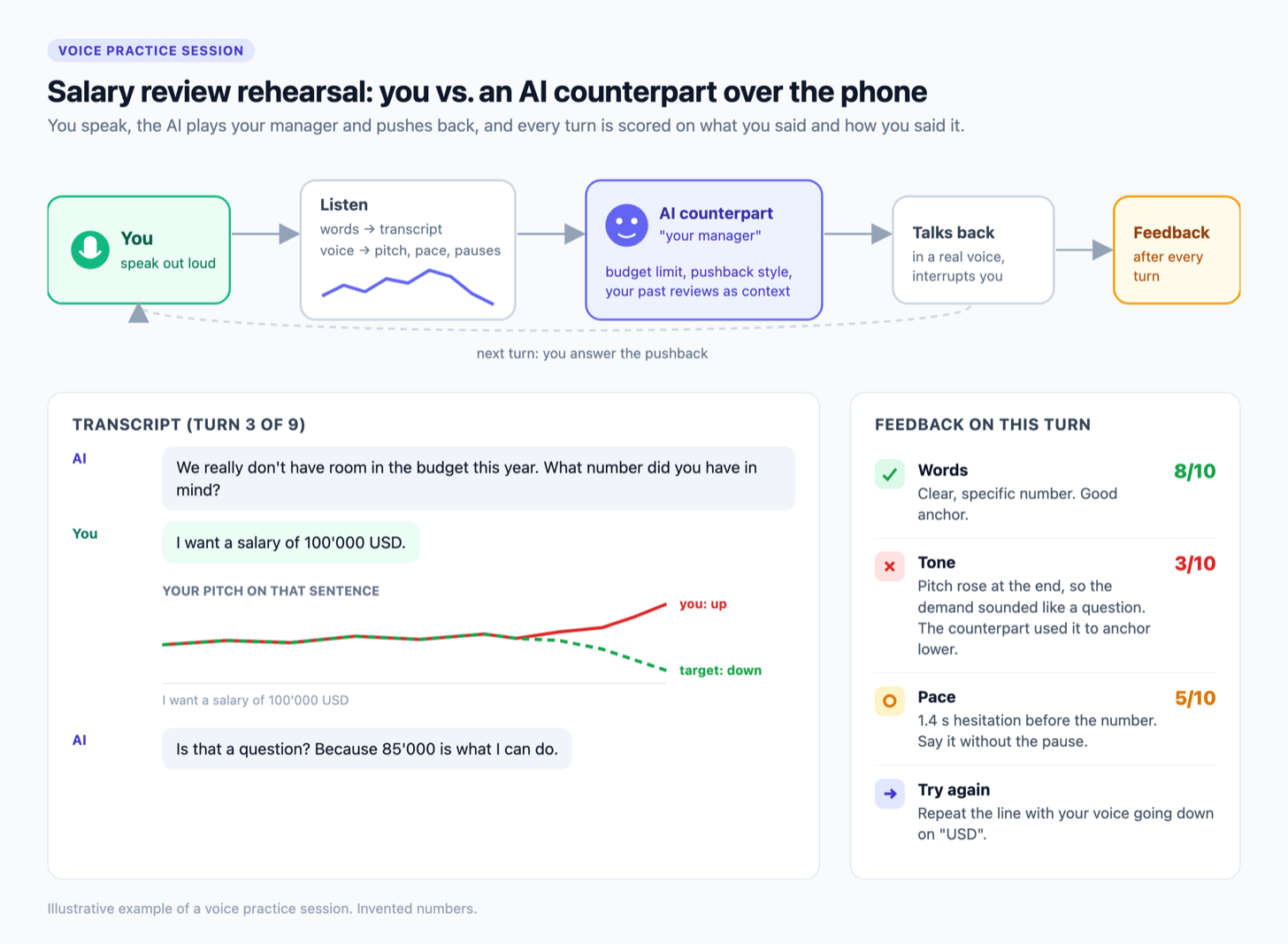
There’s also a dimension to how you present the words you say. For example, when making a statement or asking for a demand, you can make it with a tone going up, or you can make it with a tone going down. In this specific situation that I laid out here, a tone going down is obviously best because a tone going upwards usually implies a question, while when you’re making a demand, the tone should naturally go downwards.
You can try this yourself by saying this sentence out loud: one with the last tone going down, one with the last tone going up.
“I want a salary of 100’000 USD”
You can immediately tell yourself that when your voice goes downward, the message becomes clearer, and you’re more likely to get what you want.
A third dimension that I can cover here is how you present yourself visually when negotiating. You can, for example, choose to look the counterpart in the eyes or look away from them. You can choose to fidget with your fingers a lot, giving nervous impressions, and you can choose to cross your arms and legs, also indicating nervousness.
I think if you haven’t worked, practiced, or been a part of a lot of high-value negotiations before, you probably are not aware of all of these different components, and thus you need to practice.
One way to practice is to just chat back and forth with an AI agent such as Claude or ChatGPT. The problem here is that, of course, you’re only getting dimension 1, which is what you say during the negotiation. Of course, this is very important, and you can get feedback on that. But if you look into it, you’re completely missing out on the body language dimension, which probably consists of more than 50% of what matters.
Another component is that you can do a voice-to-voice call where you talk against an AI. You can, for example, do this with the latest ChatGPT feature, where you can chat in the app. Or a lot of other providers have started providing AI agents you can talk to directly, and they talk directly back at you.
I think this is getting to an area where you get really good practice. First, you get to practice what you say, and you also get to practice the tone of how you’re saying it. In practice, a lot of negotiations are over the phone, and this is basically such a practice scenario: practicing how you negotiate over the phone.
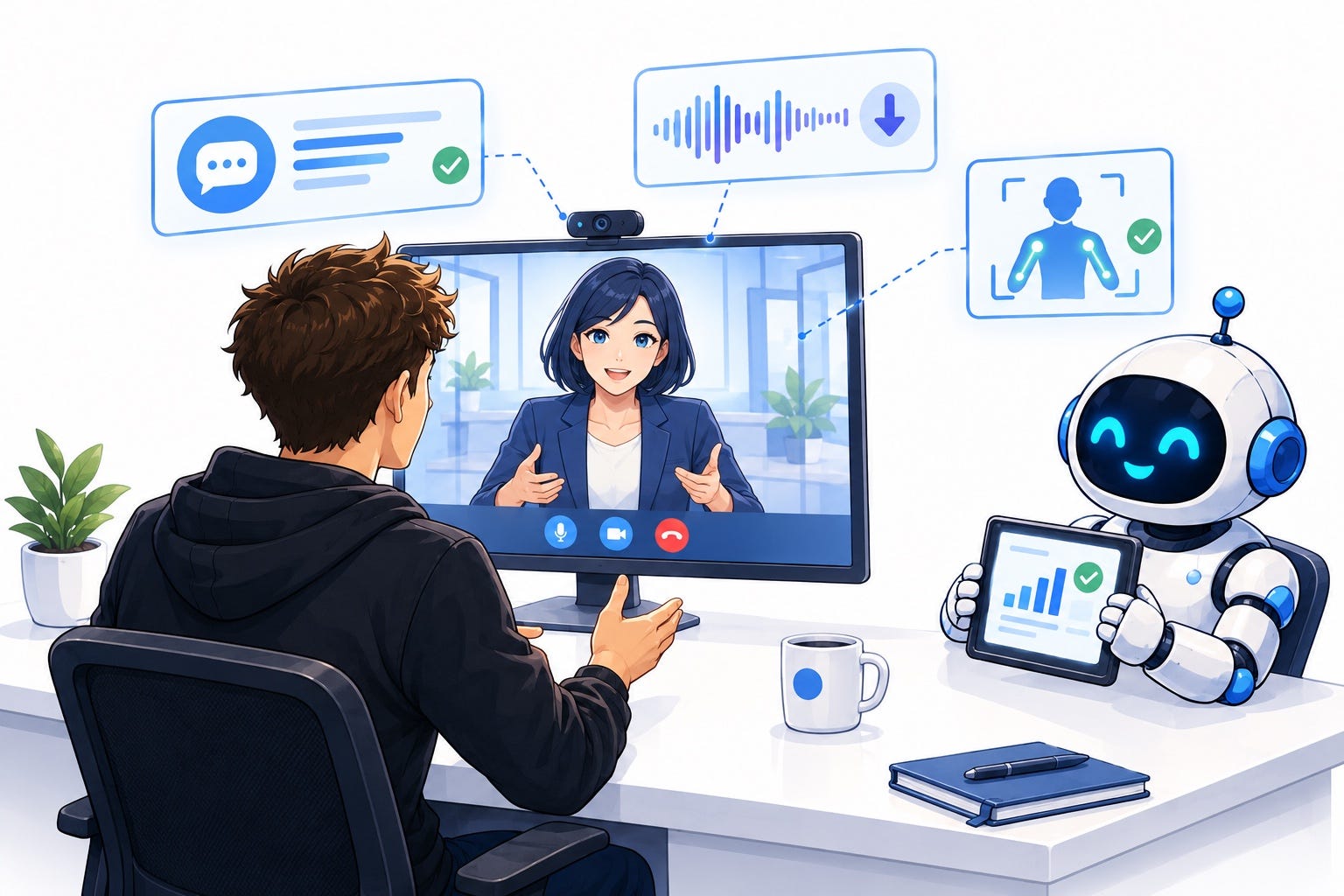
Lastly, however, you have the best sort of practice for negotiations, which is talking to a video avatar. This lets you practice all three dimensions I covered above and get feedback on both the words you present, the way in which you present the words, and how you visually present yourself when negotiating. Are you showing confidence, or are you showing nervousness?
Help during the negotiation
Now I’m going to start discussing how to get help during the negotiation. Previously, I covered what you should do when preparing for negotiation. If it’s a very important negotiation, such as a yearly salary review, I strongly urge you to start practicing well beforehand: writing down the different arguments, the different counterarguments your counterpart can come up with, and so on.
However, now it’s also time to start discussing help during the negotiation, because, of course, you can use AI beforehand, but you could also benefit greatly from having AI during the negotiation.
Imagine, for example, you’re in a long negotiation with a lot of different context: hundreds of pages of context from documents and so on. It’s a complicated negotiation with a lot of dimensions. For a human brain, it’s very hard to remember all of the different information that has been discussed earlier and that could be useful to bring up in the situation you’re currently finding yourself in.
Imagine, for example, that you’re discussing the price for buying an apartment with some discrepancies in it. Some things in the apartment have to be refurbished and fixed, and there are some different issues.
For the human brain, it can be very hard to remember all the different issues. Perhaps there were some things in the bathroom, some things in the kitchen, in the living room, and in the second bedroom, etc. It’s hard to remember, for example, how severe it was in each area, what the cost of the damage was in each area, and so on.
Now the real estate agent gives you a specific sum of money that they offer you to buy it for. You have to decide on the spot whether to say yes or no because there’s another buyer. The real estate agent says there’s another buyer ready to go.
As a human, you don’t want to make rushed decisions because you would have to go through all the numbers, calculate it, find the different data and what the issue was, the estimated price to fix it, and so on. However, if you were to have an AI with you during negotiation, this could be a simple prompt to the AI asking if this makes economic sense to you: yes or no.
This is where the power of AI during the negotiation comes in. You, as a human, can focus on the human element of the negotiation, while the facts can be brought forward to you with a few clicks on your PC, which is, of course, extremely valuable. When negotiating for high commercial assets, such as an apartment, it can either make you a lot of money or save you a lot of money, which is why receiving help during a negotiation using AI has enormous commercial value.
Conclusion
In this article, I discussed how to apply AI during negotiations and how we do it at DealSharp. We allow our users to practice before a negotiation using all three dimensions, including text, audio, and video, and get feedback on all dimensions. Additionally, we offer help during the negotiation to help our users focus on the human elements of negotiation, while all the facts can be brought forward to them by just prompting the AI with a simple question.
Related reading
👉 Find me on socials: