If you’ve studied engineering at university, you’ll probably have learned a lot about solving problems. I believe the most important thing I learned at university wasn’t the knowledge itself, but how to approach problems in general, and the different tools I can use to solve them.
For the record, I don’t think you need to go to university to learn this; there are, of course, many other approaches you can take that can be equally effective. If I look back at my first 1,5 years of working full-time, I probably learned 3 times as much as I did spending 5 years at university.
In this article, I’ll discuss the mindset I learned for solving problems, and how I apply it on a daily basis at my work as a Data Science Lead of an AI startup. I’ll try to explain my thought process and the techniques I use in the best way possible.

What are engineering principles
I interpret engineering principles as a methodology for identifying and solving problems. First, you should understand the ***why***. You need to know why, because that gives you a deeper understanding, which again allows you to understand problems, and then again, how to solve them.
For example, if you’re working with Document AI, you should understand how LLMs work and how transformers do what they do. This is important because when you encounter issues, such as if the LLM isn’t answering questions correctly, you can identify why it’s happening and how to fix it.
Furthermore, you should have a methodical and analytical mindset. You shouldn’t allow emotions to judge how you solve a problem. Your solution should be based on logical reasoning for why this is the best approach to solve a problem. Sometimes you’ll be wrong, and that’s completely fine. You might’ve had incomplete information or simply not enough knowledge on the subject.
The most important point then is to review mistakes, understand what went wrong, learn from it, and continue iterating
Fast iterations are the quickest way to solve a problem
Why you should apply engineering principles
You should apply engineering principles because it’s simply the best way to solve most problems. And I strongly believe that this applies not only to “technical tasks” such as programming. I believe you can apply engineering principles to all the problems you encounter:
Creating a successful marketing campaign
Succeeding with sales
Handling customer management
A methodical mindset will likely be an efficient approach to all of the problems listed above.
How to apply engineering principles
In this section, I’ll cover how to apply engineering principles. I’ll describe how I try to do it in my daily work, and the way I think about and solve problems.
I have a 3-step end-to-end pipeline for discovering and solving problems.
1. Identify problems
2. Prioritize problems based on value and effort
3. Write a plan, and execute it to solve the problem
I try to apply this process to everything I do. As an engineer, I always try to look for the most critical and important problems to solve. This is critical because if you’re not working on the correct problem, it doesn’t matter how good your solution is
If you’re not working on the correct problem, it doesn’t matter how good your solution is
I often refer to the quote below from Elon Musk.
The most common error of a smart engineer is to **optimize a thing that should not exist**
I think this expertly highlights the importance of step 1. You need to work on the right problems. I’ve, of course, made this mistake multiple times myself, but I try to constantly remind myself to prevent it from happening more in the future.
I’ll now cover the three steps of my problem-solving process
Step 1: Identify problems
Identifying problems is the first part of the process. I try to look at everything I’m working on and think about how I can improve it or where there are issues. To do this, I try to always get a good understanding of what I’m working on (or at least the thing I want to improve, sometimes that can be something I haven’t worked on yet).
After getting an understanding of the topic, everything becomes much clearer. It's much easier to know what’s working and what’s not working if you have a good understanding of your application.
Always try to ask people questions, with the goal of learning. Especially when you’re aware that other people know more than you on a topic, you should attempt to learn as much as possible from them.
Another approach I also apply (typically in parallel to talking to people), is to sit down and understand the topic myself. If I’m to start working on a marketing campaign, i’ll do the following:
- Prompt Gemini: “What are best practices for marketing within <my domain>”
- Read through previous marketing material and analytics (understand what works and what doesn’t)
Simply spending 2 hours doing this will immediately gain you a decent understanding of the topic. It will now be much easier for you to identify problems with the marketing and how to make it work
Step 2: Prioritize based on value and effort
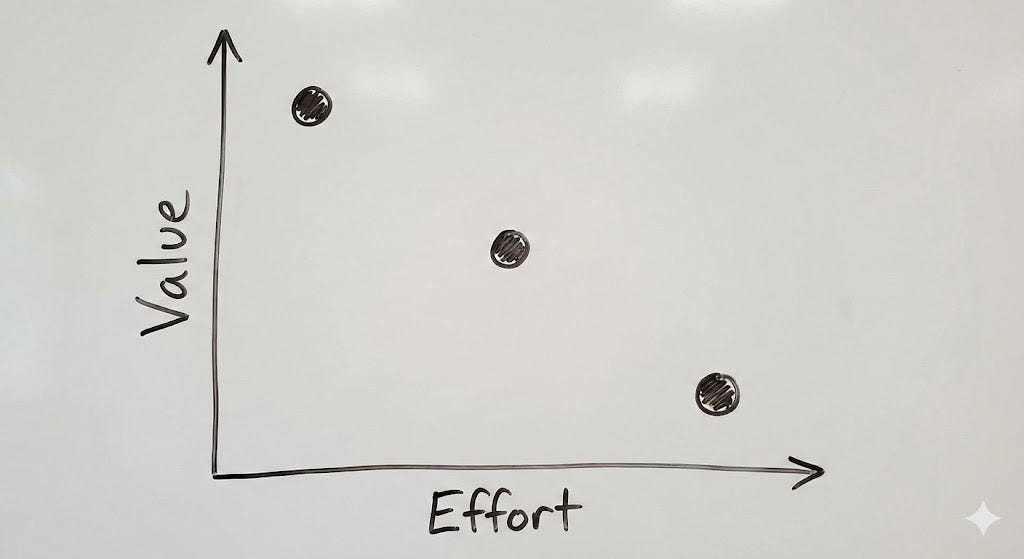
I really like the value. effort graph. The graph gives you an overview with a 2D graph. The points on the graph are each problem/topic you’re working on, and the two axes represent value gained from solving the problem, while the effort represents the effort required to solve the problem.
If you did step 1, you’ll have a good understanding of the problem, and you’ll thus have a decent intuition for both the value and the effort of a problem. You should often trust this intuition, while also discussing with others if they agree with you or not.
If they disagree, you should attempt to discover why they disagree. When you understand that you might keep the same opinion, or you might change it because of new information.
Always talk to people with a discovery mindset. Try to understand why