


AI has completely changed the way I code. Well, previously, you would have to spend some time preparing and then start implementing all the code manually, perhaps with tab completion. You can now write thousands of lines of code in a few minutes using coding agents.
Naturally, this has also changed the way you get code into development and production environments. You no longer need to rigorously read through every line of code, test it extremely rigorously and properly before taking code into production. You can now do it in a much quicker fashion.
However, one bottleneck I’ve noticed is testing with real users. You don’t want to present new features as a full rollout to all users until it’s actually been tested by real users. When I say real users, it’s a very important separation from the engineers implementing the feature and the actual people that are supposed to be using the feature.
One example is that at DealSharp, we make a tool that lawyers use, and I, as an engineer, am of course not the ideal customer profile. I need to have lawyers test the feature before we do a full general rollout.
In this article, I’ll discuss my philosophy for getting code into production as quickly as possible, making it available to a select number of users to quality assure it and iterate on it before we do a general rollout.
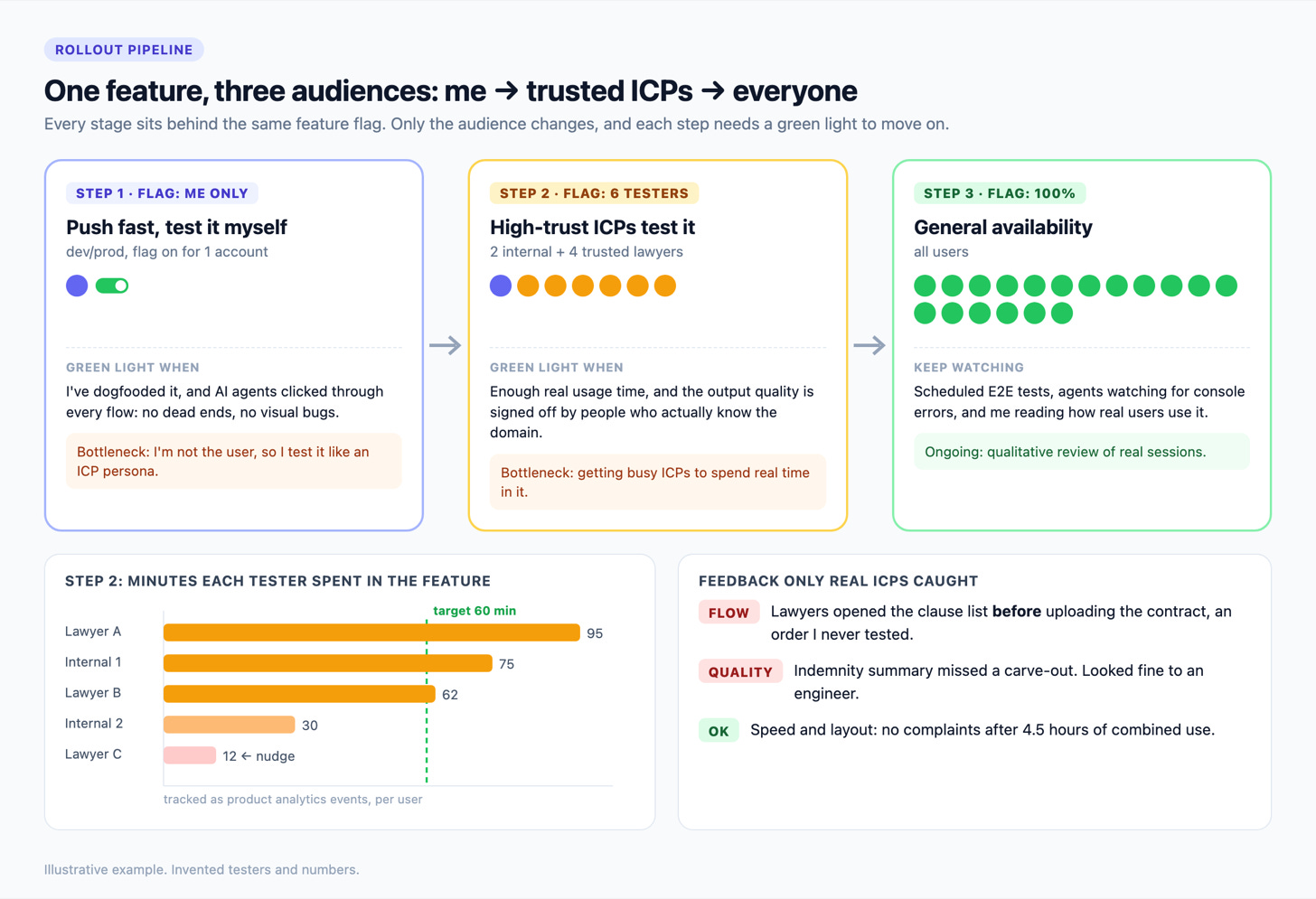
I divide this into a three-step process.
Of course, I test it myself, and perhaps I push it to dev/prod and make it a feature flag only available to me in the development environment.
I make it available to a select number of ICPs. This could be internal users that fit the ICP profile or a select number of trusted external users that I know will give me honest feedback.
A general rollout.
1. Pushing quickly with a feature flag
You shouldn’t be afraid to push code quickly and only make it available to a select number of people with a feature flag. Previously, this would, of course, cause a lot of noise in the codebase, but I think now, with coding agents, this doesn’t really matter. You’re better off getting code into the development or production environment so it’s available there and you can iterate on it, as long as it’s behind a feature flag and not generally available yet.
This, of course, allows you to push code much more quickly without having to worry too much about the quality. I think worrying too much about the code quality and feature quality before it goes in will severely slow you down and is something you should generally avoid. You, of course, have to balance this with not making it available to everyone so that actual users won’t get a poor user experience. Users should not see a feature before it’s been tested properly, both internally by engineers and by a select group of ICP users.
The first time I push something, I typically only make it available to myself. I test it a bit by dogfooding and literally using the product myself, preferably.
In an ideal world, I know that’s sometimes not possible if you would never use the feature yourself, but at least try to think like one of the ICPs and use the product as much as you can yourself. Do a thorough end-to-end test run with a lot of AI agents clicking through the features, mapping out everything that doesn’t work or that doesn’t really make sense. Maybe there are some dead ends, maybe there are some visual bugs, etc. Iterate on this yourself before moving to the next step.
2. Make it available to high-trust ICPs
The second step is to make it available to ideal customer profiles (i.e., the true users of your product, which for us would be lawyers) and have them properly test the feature out. This is very important for several reasons:
They might click other buttons than you might think make sense, or in a different order, so you need to understand how they see the product from their perspective.
The quality of the output from the AI might also need to be tested, which is hard to do if you’re not the actual user of the product. It’s sometimes hard, for example, for an engineer to verify the legal quality of output when drafting agreements and so on.
One of the bottlenecks of this step could be to actually have these people test the product out properly. I’d like to measure the testing in terms of the number of minutes or hours a user has used the feature. You can, for example, track this using PostHog, and you should aim for people to use a new feature as much as possible. Quite a large amount of feedback can only be given through actually testing the product for an extended period of time, and it’s very hard to fake that time. You just need to put in the time and effort into actually testing it.
A challenge here can be to get these high-trust ICPs to actually test it, especially if you don’t have anyone internal. You’ll probably just have to nag some people that you trust a lot to get feedback as quickly as possible and to try to move through this step as quickly as possible.
3. General availability
The third step is, of course, to make a feature generally available after you’ve gone through step two and gotten a green light. I think once you make it generally available, it should be tested for many, many hours, both by real humans and coding agents, clicking around thoroughly. You should also make sure to set up end-to-end tests that run on a regular basis to see if anything drifts away from expected performance, and monitor real user usage of the new feature that you developed.
This monitoring should happen both through AI agents watching them, seeing if they get any console errors, for example, but also through you looking at how the specific users use the feature and seeing if there’s anything unexpected. I think qualitative analysis of data has become an undervalued resource in the age of AI, where you have extremely powerful LLMs that can, of course, do quantitative and qualitative analysis. You should sometimes be simply spending time doing qualitative analysis.
Conclusion
In this article, I discussed my AI coding implementation philosophy and how I push features as effectively as possible while also maintaining high quality. I think the most important part of this is that, of course, you test things thoroughly and make sure to follow all the feedback you get, while also trying to go through this three-step loop that I covered as quickly as possible. The goal of any feature, especially in the age of AI development, is to get it out as quickly as possible. You should always work to analyze and optimize the three-step loop that I covered in this article to increase your coding iteration speed. You’ll probably encounter different bottlenecks as you try to optimize it.
In step one, a bottleneck could be, for example, that you wouldn’t use the feature yourself, so it’s very hard for you to test it. If so, you should, for example, try to spin up AI agents with a specific persona of the target ICPs so they can test more thoroughly for you. You should try to get in the mind of your ideal customer profile to test as similarly as possible for them as you’re able to.
In step two, a bottleneck is probably getting access to actual ICPs that are willing to spend time testing your feature.
These are just bottlenecks you have to work through and continue trying to optimize to make the loop as quick as possible.
Related reading
👉 Find me on socials: